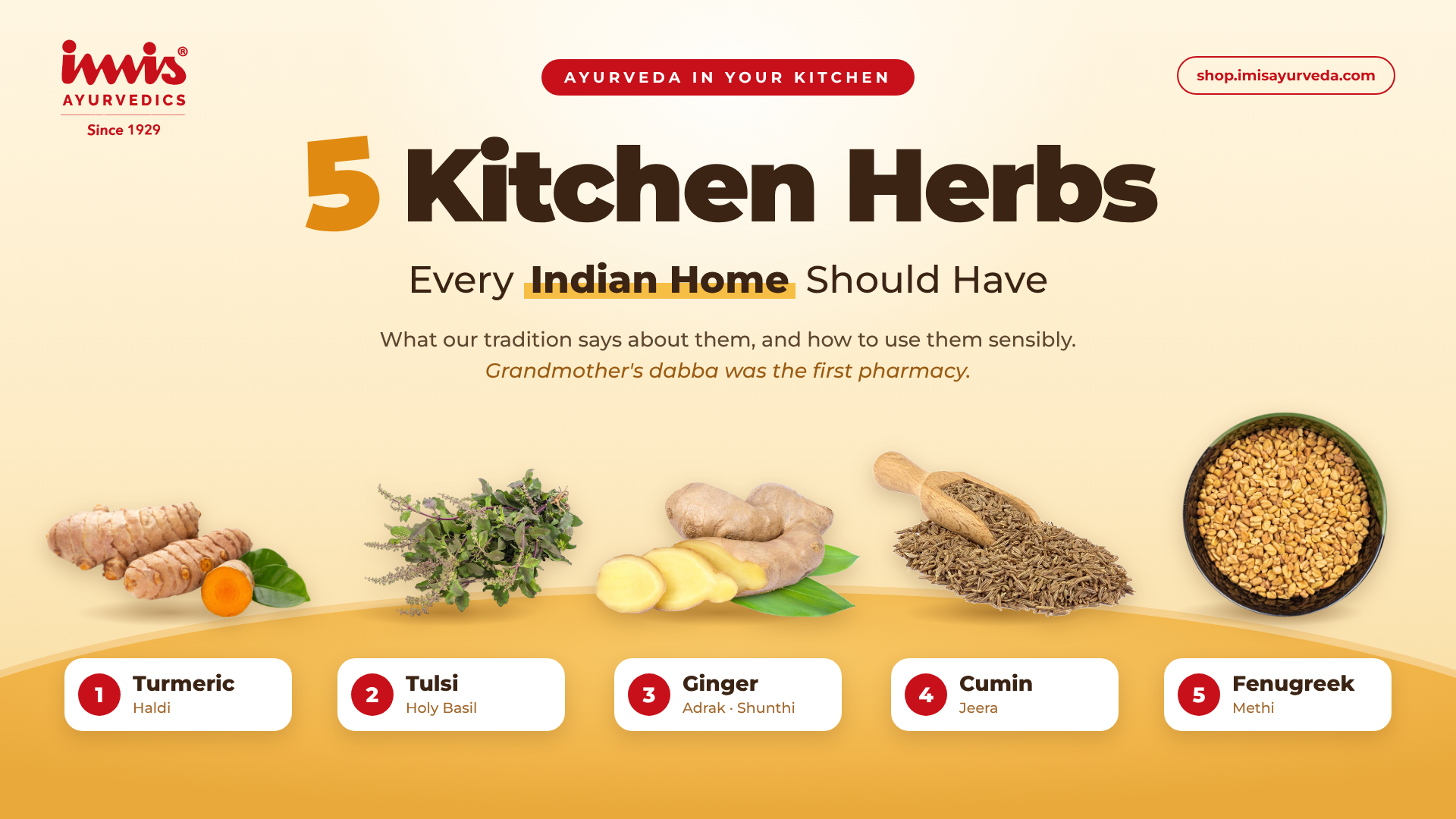
Open any Indian kitchen cupboard and you will find a small steel dabba of kitchen herbs and spices with six or seven compartments. Jeera in one, haldi in another, methi seeds somewhere at the back that nobody has touched in months.
Most of us think of these as flavour. Our grandmothers thought of them as something else entirely.
Have you ever wondered why, when someone had a cold at home, nobody rushed to the chemist first? The kitchen was the first stop. Not because medicines were unavailable, but because Ayurveda has always treated food and medicine as a continuous thing rather than two separate departments. The word aushadha covers both.
Let us look at five of these everyday Indian kitchen herbs. We will see what our Ayurvedic tradition says about them and how to use them sensibly.
1. Turmeric (Haldi)
We add it to almost everything, so much so that we have stopped noticing it.
Ayurveda values turmeric as a deepana and pachana substance. This means it supports the digestive fire and helps process food properly. Tradition describes it as bitter, pungent and drying in nature. Classical practice uses it in skin conditions, in wound care, and in preparations for the respiratory system.
The famous haldi doodh at bedtime is a straightforward home use of it. The world rediscovered this drink a few years ago and renamed it golden latte. However, here is a word of caution that the internet usually leaves out. Turmeric is warming and drying, so very large quantities can aggravate pitta in some people. The pinch in your dal is the traditional dose. A heaped spoon three times a day is not.
2. Tulsi
Almost every older home had a tulsi plant in the courtyard, and in many families it still receives water and a diya each morning.
The reverence is religious, but the placement was practical too. Families have traditionally used tulsi for coughs, colds, blocked noses and general seasonal discomfort. Ayurveda describes it as warming and supportive of the respiratory channels. A few fresh leaves boiled in water with ginger is still one of the most common household responses to the first sneeze of the season.
This is a good point to be clear about something. Tulsi kadha is a comfort measure and a traditional practice. It is not a treatment for pneumonia or for a fever that will not break. Know the difference, and see a doctor when the situation calls for one.
3. Ginger (Adrak / Shunthi)
Ayurveda gives ginger a very high place. It is sometimes called vishwabheshaja, meaning the universal medicine, in traditional usage.
Ayurveda treats fresh ginger and dried ginger as two different substances. People use fresh adrak to kindle appetite before a meal. Dried shunthi, on the other hand, is heavier and more warming, and features in many classical formulations for digestion and for joint discomfort.
The old habit of chewing a small piece of ginger with rock salt before lunch was not a snack. It was a deliberate step to wake up digestion before food arrived. If you eat lunch at your desk at half past three because a meeting ran over, this small practice is genuinely worth reviving.
Those with acidity or ulcers should go easy, since ginger is heating by nature.
4. Cumin (Jeera)
The most underestimated thing in the dabba.
Cooks across India use jeera precisely because it makes food easier to digest. That first crackle of cumin in hot ghee is not only for aroma; it is also a digestive step built into the recipe.
Jeera water, which many families drink after heavy meals or during the summer, is the simplest home remedy in existence. Boil a teaspoon of cumin in water, let it cool, and drink it through the day. For the bloated, uncomfortable feeling after a wedding lunch or a festival meal, this remains the standard household answer in most Indian homes.
Cumin is also one third of the well-known jeera-dhania-saunf combination that many people keep as an after-meal water.
5. Fenugreek (Methi)
The one at the back of the dabba that deserves better treatment.
Methi seeds are bitter, and Ayurveda considers bitterness useful rather than unpleasant. Tradition uses the seeds in the care of digestion and of the joints. Methi is also a familiar part of postnatal care in many Indian households, where new mothers receive methi laddoo or methi in various forms.
The common home practice is to soak a teaspoon of seeds overnight and take the soaked seeds, or the water, in the morning. Methi is also widely used in hair care, ground into a paste for the scalp.
People on diabetes medication should speak to their doctor before taking methi regularly. This is because methi can affect blood sugar, and doses may need adjusting. This is exactly the kind of interaction worth taking seriously rather than assuming that a kitchen ingredient is automatically harmless.
Where This Idea Comes From
There is a moment described in traditional accounts of Ayurveda’s origins that explains this kitchen-as-pharmacy thinking rather well.
The story tells of Punarvasu Atreya, a teacher in the ancient tradition, sending his students out to gather plants that had no medicinal use. His student Jivaka returned empty-handed, saying he could not find a single one.
Whether this happened exactly as described, we cannot say. It is a teaching story preserved in tradition rather than a documented event. But its point stands: Ayurveda does not divide the world into medicine and non-medicine. It sees usefulness everywhere, provided you know the right quantity, the right season and the right person.
The Sensible Way to Use Indian Kitchen Herbs
A few honest rules.
Small, regular, everyday use is where Indian kitchen herbs actually work. Sudden large doses because you read something online are not the traditional approach and can cause problems.
These are supportive measures, not replacements. If you are receiving treatment for a condition, stay on your treatment.
And do tell your doctor what home remedies you are taking regularly. Methi, turmeric and ginger in daily quantity can interact with prescribed medicines, and doctors can only account for what they know about.
Our elders were not being quaint when they reached for the dabba first. They were using a system that had thought carefully about food. The dabba is still there in your kitchen. You only need to open it with a little more attention.
Caution: Individual health needs vary. Those on medication, pregnant women, and parents giving remedies to children should consult a qualified Ayurvedic practitioner or doctor before making regular use of any herb.