Walk into any beauty aisle today and you will find a row of small glass bottles with droppers, each promising brightness, glow, radiance. Serums have become the most talked-about step in skin care.
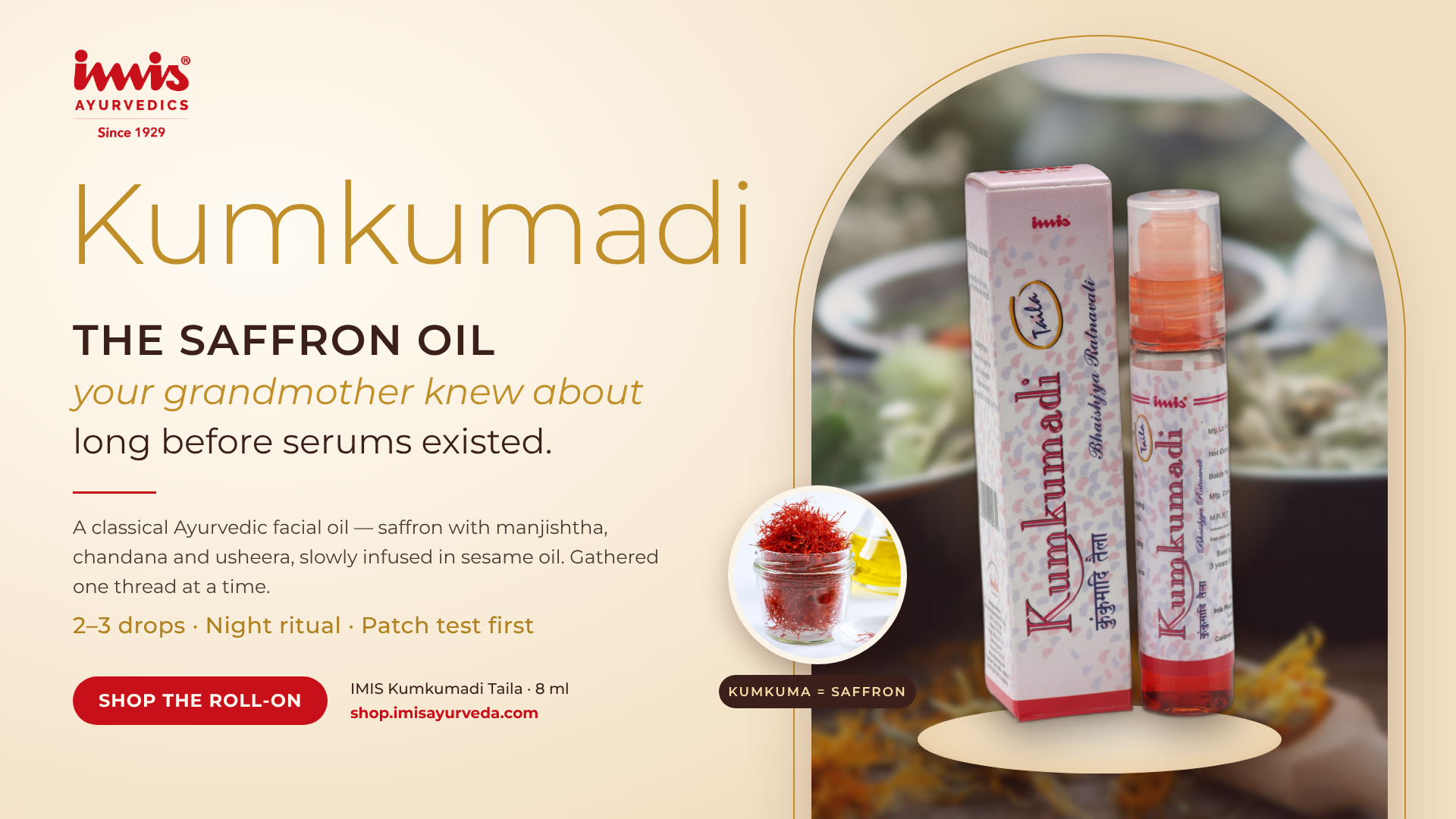
Here is something many people don’t realise. Ayurveda had a facial oil of exactly this kind long before the word serum entered our vocabulary. It is called Kumkumadi Taila (also known as Kumkumadi oil), and its main ingredient is one of the most expensive things in any Indian kitchen: saffron.
If you grew up watching your mother or grandmother keep a small dark bottle aside, used sparingly, a drop or two at a time, there is a good chance it was this.
What Is Kumkumadi Taila?
The name comes from kumkuma, the Sanskrit word for saffron. Kumkumadi Taila is a classical formulation, which means it is not somebody’s modern invention but a preparation described in traditional Ayurvedic texts, made to a set recipe.
Saffron leads the formula, supported by other herbs traditionally associated with the complexion, such as manjishtha, lodhra, chandana and usheera, processed in a base of sesame oil and milk. The herbs are slowly infused into the oil in stages, so that their properties transfer into it. That is also why a genuine Kumkumadi Taila is never cheap. Saffron alone sees to that.
Traditionally it is classified under varnya preparations, meaning those used to improve the complexion, and it has long been used for dullness, uneven tone, marks left behind by pimples, and general tiredness of the face.
Why Ayurveda Looks at Skin Differently
This is where Ayurveda takes an interesting approach.
Modern skin care usually treats the face as a surface to be corrected. Ayurveda treats it as a display board. What shows on your skin is understood as a reflection of what is happening underneath, particularly with digestion, sleep and the state of the doshas.
Dullness and pigmentation are generally linked to aggravated pitta and to the accumulation of ama, the residue of incomplete digestion. Dryness and early fine lines lean towards vata. Oiliness and congestion lean towards kapha.
So a traditional vaidya would not simply hand over an oil. He would ask what you eat, how your stomach feels in the morning, and what time you sleep.
The Saffron Field of Kashmir
Saffron has always carried a certain mystique in India, and the stories around it reflect that.
In Kashmir, the arrival of saffron is traditionally credited to two wandering Sufi saints, Khwaja Masood Wali and Hazrat Sheikh Shariffuddin. As the local account goes, they cured a sick chieftain, who offered them a gift in return, and they asked instead for a saffron bulb. From that bulb, the story says, the saffron fields of Pampore grew.
This is regional folklore rather than documented history, and different versions of it circulate in the valley. But it tells you something true about the plant’s standing. Saffron was valuable enough that its arrival needed a story worthy of it.
The practical reasons behind the price are less romantic. Each crocus flower yields only three red stigmas, and they must be picked by hand, in the early morning, in a short autumn window. It takes an enormous number of flowers to produce a single kilogram. When you use a drop of Kumkumadi oil, you are using something that was gathered one thread at a time.
How to Use Kumkumadi Oil
Most people who see no benefit from Kumkumadi oil are using it wrongly. A few points help.
Use very little. Two or three drops for the whole face is plenty. This is a rich, herb-infused oil, not a moisturiser to be slathered on.
Apply at night, on clean skin. Warm the drops between your palms, then press and massage gently upward for a minute or two. If your skin feels heavy in the morning, wash the face with a mild cleanser.
Give it time. Traditional preparations work gradually. Judging a classical oil after four days is like judging a young mango tree after one season.
Patch test first, especially if your skin is sensitive or acne-prone. Try a little behind the ear or on the inner forearm for a couple of days before putting it on your face.
If your skin is very oily or you are going through active, inflamed acne, check with an Ayurvedic physician before starting. An oil is not the right answer for every skin type, and honest Ayurveda admits that.
Two Common Misunderstandings About Kumkumadi
“It will make my skin fair.” No. And it is worth saying plainly. Kumkumadi Taila is traditionally used to improve clarity, evenness and the general glow of the skin. It does not change the colour you were born with, and any product that claims to is selling you something other than Ayurveda.
“Natural means it suits everyone.” Also no. Saffron, sesame oil and strong herbs are potent things. Potency and safety are not the same. People on medication for skin conditions and anyone with a history of allergies should ask an Ayurvedic practitioner before beginning.
The Part Nobody Wants to Hear
Ayurveda’s view is that good skin is mostly built, not applied.
Sleep before eleven where you can. Drink enough water through the day, not all of it in the evening. Go easy on the very spicy, very oily and very sour food if your skin runs hot and breaks out, especially through the summer months. Keep the bowels regular, which our elders were far less shy about discussing than we are.
Do these, and an oil like Kumkumadi has something to work with. External applications cannot compensate for poor lifestyle practices.
That is not a fashionable message. But it is an honest one, and it has been the same advice for a very long time.
Caution: For external use only. Individual skin needs may vary. If you have a skin condition or are already using prescribed treatments, please consult a qualified Ayurvedic practitioner or dermatologist before starting a new product.