Introduction
Autumn often feels paradoxical. The monsoon rains have receded and the skies are clearer. Yet many people complain of burning sensations, hyperacidity, indigestion, and sudden flare-ups of skin rashes or allergies. Ayurveda offers a profound explanation for this rise in acidity and skin rashes: this is the season when Pitta dosha naturally aggravates.
Autumn may appear calm outwardly, but inside the body it stirs hidden heat. During the rainy season, the body adapts to cool dampness. The Pitta dosha has already increased during Varsha (monsoon). So when the sharp rays of the autumn sun suddenly strike the body, Pitta becomes greatly aggravated in Sharad Ritu (autumn).
Understanding Pitta Dosha
In Ayurveda, Pitta is the principle of transformation, formed by the elements of fire (Agni Mahabhuta) and water (Jala Mahabhuta). When in balance, it governs digestion, metabolism, body temperature, vision, hunger, thirst, and appetite. It also sustains skin complexion, intelligence, courage, and the suppleness of the body.
Seasonal Dynamics
- Summer: Heat accumulates in the body.
- Rainy Season (Varsha Ritu): Dampness suppresses outward expression of heat.
- Autumn (Sharad Ritu): Clear skies and sharp sunlight reactivate stored heat, leading to Pitta prakopa (aggravation).
In short, Pitta in autumn is like a volcano: dormant during the rains, but erupting when autumn sunlight strikes.
Seats and Subtypes of Pitta
Pitta resides in multiple sites: Nabhi (umbilicus), Amashaya (stomach), Sweda (sweat), Lasika (lymph), Rudhira (blood), Rasa (plasma), Druk (eyes), and Sparshanam (skin). Above all, its special seat is the Nabhi region.
Subtypes of Pitta and Modern Correlations
- Pachaka Pitta: Located between stomach and large intestine. Governs digestion, comparable to gastric acid, enzymes, bile salts, and gut hormones. Dysfunction parallels hyperacidity and indigestion.
- Ranjaka Pitta: In stomach and liver, transforms Rasa Dhatu into Rakta Dhatu. Correlates with hemoglobin synthesis, liver metabolism, and bilirubin.
- Sadhaka Pitta: In the heart, governs intellect, emotions, and consciousness. Linked to neurotransmitters and the heart–brain axis.
- Alochaka Pitta: In the eyes, supports vision. Correlates with photopigments and visual pathways.
- Bhrajaka Pitta: In the skin, governs complexion and thermoregulation. Correlates with melanin, barrier function, and absorption.
Effects of Pitta Aggravation in Autumn
When aggravated, Pitta’s fiery qualities — ushna (heat), tikshna (sharpness), drava (fluidity) — dominate, producing systemic effects:
This imbalance shows up in different systems of the body:
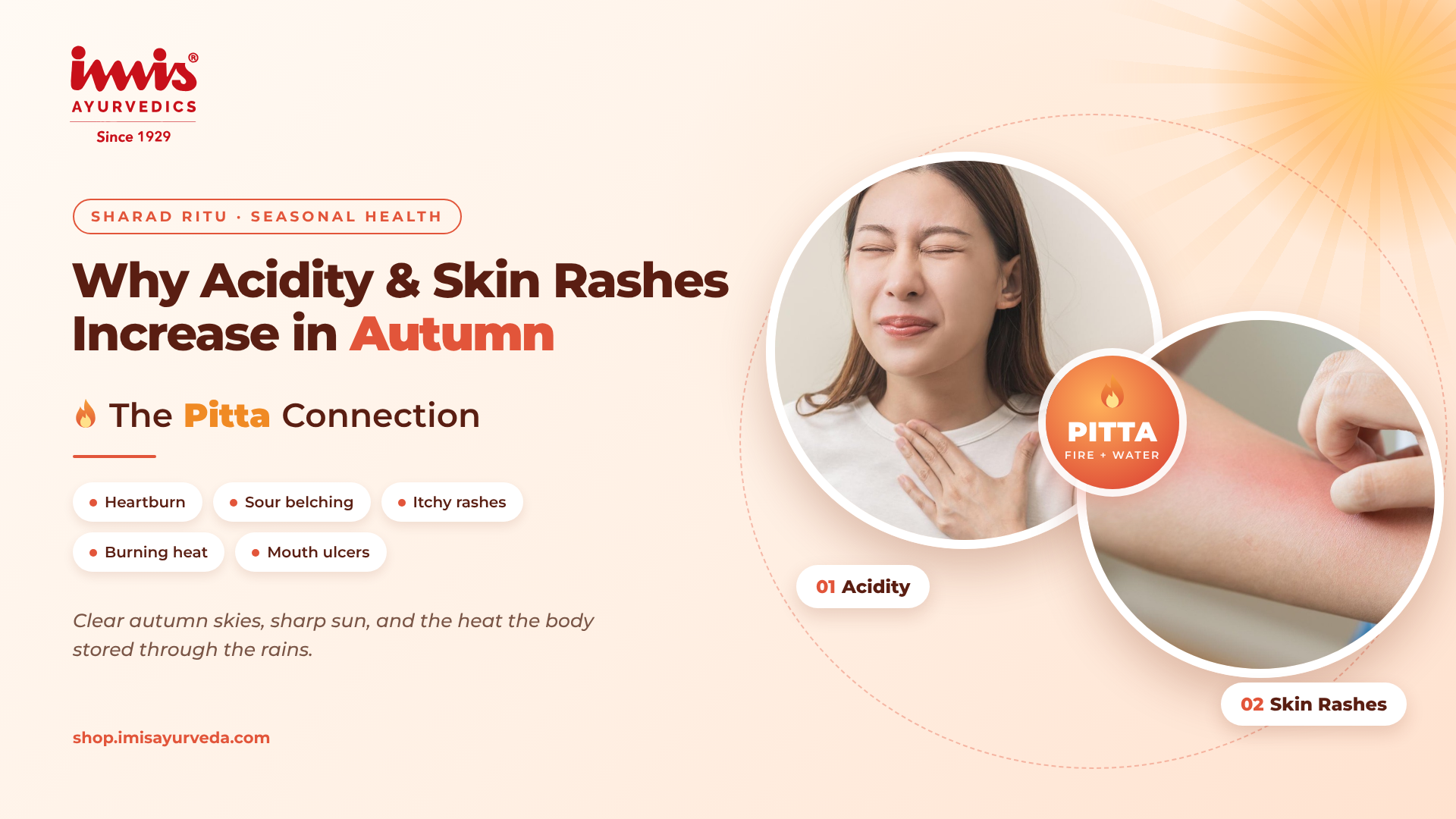
- Digestive System: Excess acid production leads to heartburn, sour belching, nausea, and burning sensations in the stomach. Ayurveda calls this Amlapitta (hyperacidity).
- Skin and Blood: Heated blood (rakta dushti) irritates the skin, causing rashes, hives, acne, or eczema flare‑ups. The skin may feel itchy, red, or inflamed.
- Mouth and Eyes: Mouth ulcers, burning in the throat, and redness in the eyes are common signs of aggravated Pitta.
- Systemic Symptoms: Excessive thirst, sweating, and a feeling of internal heat or burning in the body.
- Mental State: Irritability, impatience, anger, and restlessness often accompany physical symptoms, since Pitta also governs intellect and emotions.
Skin Rashes in Autumn
Seasonal changes in temperature, humidity, sweating, sunlight, and environmental exposure can influence how often skin conditions occur and how severe they are. For example, Indian studies have reported seasonal variation in eczema, fungal infections, and other dermatological disorders, particularly during warmer and more humid periods. This seasonal increase in complaints during Sharad Ritu (autumn) aligns with the Ayurvedic concept of Pitta Prakopa. Meanwhile, modern environmental factors provide complementary explanations.
From a contemporary perspective, climate‑related skin inflammation offers a useful framework. Fluctuations in temperature and humidity affect the skin barrier, sensory nerves, and immune system:
- Temperature‑sensitive channels (TRPV1, TRPV3, TRPV4) respond to heat stimuli.
- Humidity changes alter skin‑barrier proteins such as filaggrin, mediated by peptidyl‑arginine deiminases (PADs).
- As a result, these mechanisms increase transepidermal water loss, sensitivity, and susceptibility to irritants.
- Excessive UV exposure generates reactive oxygen species and activates inflammatory pathways (MAPK, NF‑κB, AP‑1), leading to mediator release.
Together, these processes explain why certain seasons bring out the symptoms traditionally linked with Pitta aggravation: Daha (burning), Raga (redness), Kandu (itching), sweating, and inflammatory eruptions. In modern dermatology, these manifestations involve Th2/Th22 immune responses, cytokines such as IL-4, IL-13, IL-31, and disruption of the epidermal barrier. While no one can equate Pitta to a single gene or enzyme, its Ayurvedic description shows striking parallels with biological responses to environmental stress. However, researchers still need to explore these connections at the molecular level.
Acidity in Autumn: Ayurvedic and Modern Perspectives
Among the five subtypes of Pitta, Pachaka Pitta is most directly involved in digestion and gastric functions. It governs digestion and transformation of food and has a close link with Jatharagni. When Pachaka Pitta becomes excessive or disturbed, its Ushna (hot), Tikshna (sharp) and Drava (liquid) qualities can become predominant. This can contribute to symptoms such as excessive sourness, burning sensation, acid regurgitation, indigestion and Amlapitta. Ranjaka Pitta, located primarily in the stomach and liver, takes part in transformation and metabolism. Meanwhile, Sadhaka Pitta may contribute indirectly through its relationship with the mind and emotional stress. Thus, seasonal Pitta aggravation, disturbed Agni and inappropriate dietary habits can collectively contribute to the Ayurvedic pathology of Amlapitta (acidity) in Sharad Ritu (autumn).
From the modern physiological perspective, acidity primarily relates to gastric hydrochloric acid secretion and, importantly, to acid exposure of the oesophagus during gastroesophageal reflux. Gastrin, histamine and acetylcholine mainly regulate gastric acid secretion. These stimulate the parietal-cell H⁺/K⁺-ATPase proton pump. Increased acid secretion, impaired gastric emptying, transient relaxation of the lower oesophageal sphincter or increased oesophageal sensitivity can therefore produce heartburn and acid-related symptoms. Interestingly, epidemiological evidence also suggests a seasonal pattern: a large study involving 76,636 GERD-related clinical visits reported a seasonal variation in GERD incidence. It peaked during October–December and declined thereafter. The study also examined climatic factors including temperature, humidity, atmospheric pressure, rainfall and sunshine. Of course, this does not prove that autumn weather directly causes acidity. Still, it provides an interesting modern epidemiological observation that coincides with the Ayurvedic description of increased Pitta-related disorders during Sharad Ritu.
Therefore, by following the proper Sharad Ritucharya (seasonal regimen), we can prevent the aggravation of Pitta. In turn, this reduces the risk of acidity, skin rashes, and related complaints that peak in autumn.
Supportive Formulations (IMIS)
Certain Ayurvedic formulations can help manage these seasonal complaints:
Caution: Take these formulations only under the guidance of a qualified Ayurvedic physician. The appropriate dosage, suitability, and duration of use vary according to an individual’s constitution (prakṛti), age, health condition, and severity of symptoms. Self-medication without proper consultation may not address the root cause effectively and can sometimes lead to unwanted effects.