
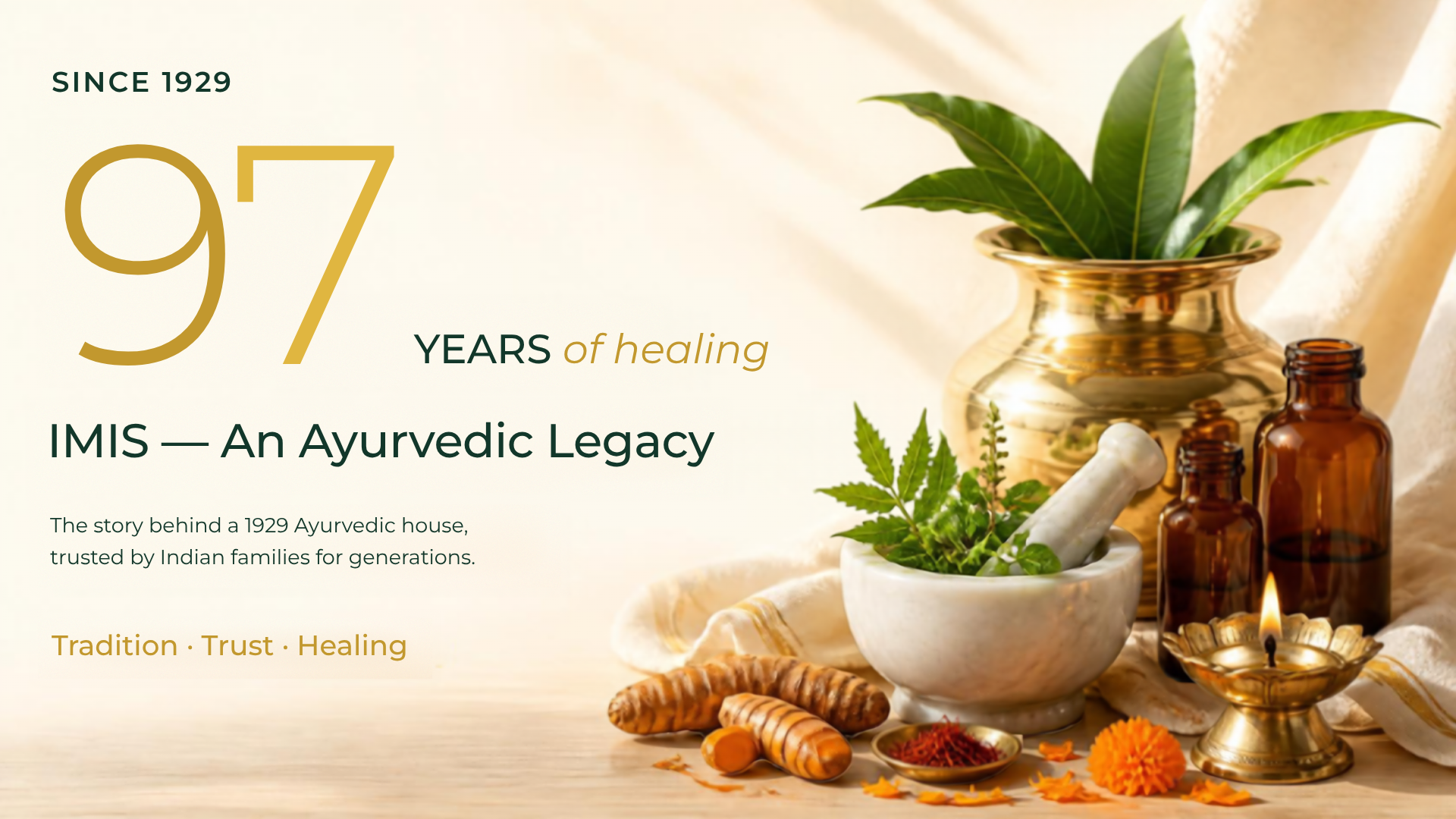
Think about what India looked like in 1929. There was no television, very few telephones, and medicines were not something you ordered on an app at eleven at night. In most homes, health care began in the kitchen and ended at the door of a local Vaidya, who knew not just your symptoms but your family, your food habits and your temperament.
That is the India in which IMIS Ayurveda began.
Nearly a century later, the name still stands, and the same idea still runs underneath everything we make: good health should be within reach of ordinary people, not just those who can afford it.
Why a 1929 Start Date Actually Matters
You may have noticed that almost every wellness brand today calls itself “traditional” or “authentic”. The words have become a little tired. So it is fair to ask what difference nearly ten decades really make.
Here is what it comes down to. Ayurveda is not a collection of recipes. It is a system of reasoning about the body, and formulations behave differently depending on the quality of herbs, the season they were collected in, how long they were processed, and in what medium. A taila that is cooked properly is not the same product as one that is rushed. These are things you learn slowly, by making the same medicine again and again across decades, and by hearing back from the people who used it.
That accumulated feedback is the real inheritance of an old Ayurvedic house. No one can buy it or write it down completely.
The Story Behind the Diya of Ayurveda
There is a well-known account in our tradition that explains where this knowledge is believed to have come from.
During the churning of the ocean, the Samudra Manthana, the devas and asuras pulled at Mount Mandara using Vasuki as the rope. Many things emerged from those waters. Towards the end, a figure rose holding a pot of amrita in his hands: Dhanvantari, honoured in our tradition as the divine physician and the one from whom Ayurveda is said to have descended to the sages, and onward to physicians like Charaka and Sushruta.
This is a traditional account from the Puranas rather than a historical or scientific record. But notice what it tells us about the culture that preserved it. Of everything that could have emerged from that ocean, the story gives the final and highest place to healing. Health was not treated as a minor domestic concern. It was placed alongside the divine.
That is also why Dhanvantari Jayanti, observed just before Diwali, is still marked in many Ayurvedic families and pharmacies across India.
What Ninety-Seven Years Teaches a Company
A business that survives this long in medicine survives for one reason only: people kept coming back.
Ask around in the Telugu states and you will often find that the connection to IMIS came through a family member. A grandmother who used our Omu Water for colic pain of the children; a grandfather who kept a bottle of Narayana tailam in the cupboard for his knees; a mother who applied Neeli Bhringaraja tailam to the hair of her daughters to ensure dark, lustrous hair; a father who popped Chitrakadivati pills in the mouths of his children when they complained of stomach pain or indigestion; a daughter who trusted Kumkumadi Lepana for the skin long before saffron-based skin care became fashionable on Instagram.
This is how Ayurvedic houses actually build their reputations in India. Not through advertising, but through a daughter-in-law being told, quietly, in the kitchen, what worked in that house.
Over the years the range grew to More than 600 products to cover the concerns that keep coming up in Indian homes. Mandara Lepana for the hair and scalp. Rheumaheal and Lumbaheal for those whose knees and lower back protest after long hours of sitting or standing. Manasamitra Gutika, a classical preparation traditionally used in the care of the mind. Dhanvantari Taila, named after the very physician of that ocean story. Roja Pushpa Lehya, Pithorin, and others besides. Some are classical formulations, prepared as the old texts describe. Others are proprietary medicines developed by our own physician–ancestors over time.
The Part That Did Change
It would be dishonest to claim nothing changed since 1929. A great deal did and had to.
Today we must test herbs, not simply trust them. Batches need documentation. Manufacturing has to meet modern good manufacturing practice standards, with proper quality control at each stage. We no longer depend only on a physician’s judgement of a raw material by sight and smell, though that skill still matters.
One may assume that this kind of standardization dilutes Ayurveda. But it is the other way around. If a classical text specifies a particular herb, processed a particular way, then testing is how you make sure that is exactly what reaches the patient. Consistency is not the enemy of tradition. It is what allows people to trust tradition at scale.
What has not changed is the principle behind the work: treating the person rather than only the complaint and keeping medicines affordable enough that an ordinary family can actually complete a course of treatment.
IMIS Ayurveda: Ninety-Seven Years, and Still Counting
Anniversaries invite a certain amount of sentimentality, so let me end with something plainer instead.
An Ayurvedic company does not last ninety-seven years because it is clever. It lasts because enough families, over enough generations, found that what was in the bottle did what it said it would. That trust was handed to us. We are only its present custodians.
If your family has a bottle with our name on it sitting in a cupboard somewhere, you are already a part of this story!
Caution: Individual health needs vary. Readers with medical conditions, those on medication, pregnant women, and parents buying for children should consult a qualified Ayurvedic practitioner or healthcare professional before starting any new medicine.


